


Politics
/
September 17, 2026
We’re keeping an eye on their races to find out. Here’s where things stand.
Rebecca Cooke, Bob Brooks, Dan Osborn, and Brian Poindexter.
(Steven Garcia / Bloomberg via Getty Images; Erin Blewett / AP; Nikos Frazier / Omaha World-Herald via Getty Images; Nate Manley / AP)
For years, those of us who have argued that Democrats should be running more working-class, unapologetically economically populist candidates have had to make our case largely in theory. Since there were vanishingly few real-world Democrats who fit the bill—particularly in competitive districts—we would show survey-takers a hypothetical ironworker who railed against corporate elites and corrupt politicians, and test whether they liked him better than a hypothetical lawyer whose main issue was Donald Trump’s threats to democracy.
But 2026 is different. There are a host of flesh-and-blood working-class progressive populists on the ballot in swing districts across the country this year—from Senate hopefuls like Maine’s Troy Jackson and Nebraska’s Dan Osborn to Ohio gubernatorial candidates Aaron Ford and Amy Acton, to the “Blue-Collar Brigade” of House candidates running in California and Pennsylvania and many places in between.
We at the Center for Working-Class Politics wanted to know what happens to candidates like these over the course of a campaign, and whether their working-class economic populism turns out to be an asset or a liability. So we chose four candidates running in broadly comparable places—three Republican-held House seats and one Senate seat with a Republican incumbent—and, together with the polling firm Nira Data and The Nation, we launched the Economic Populist Tracker to follow their campaigns from now through Election Day.
Each month through November, Nira Data is surveying 1,200 to 1,500 voters in each of the four states and districts. These are places with little consistent public polling, so the surveys can tell us something otherwise hard to know: whether these candidates’ working-class, economic populist appeals are helping them run ahead of what their districts’ normal partisan leanings would predict, and what obstacles they are hitting as the election draws closer. We are also tracking the candidates’ ads, speeches, and press coverage to see how they present themselves and how their opponents respond. Results will run in The Nation each month, with a final assessment after the election.
We have no role in any of these campaigns; we are not advising them or polling for them. Our aim is to find out whether progressive economic populism can deliver in the races that matter most, and what separates the candidates who make it work from those who don’t.
The August results of our tracker give economic populists real grounds for optimism. But they also came with some clear warning signs. All four candidates are within reach of winning, and each has a bloc of undecided voters tailor-made for their message. And in three of the four races, voters are far more likely to see the Democrat as a working-class candidate than the Republican. That matters, because our research on every congressional candidate since 2010 finds that working-class candidates draw more support from working-class voters than other candidates do—exactly the voters economic populists in swing districts need to win over most.
Current Issue

But at the same time, these candidates are not effectively reaching some of the voters they’re running to reach. Only one of the four candidates is running ahead of the Democratic Party among working-class voters. In three of the four races, only a minority of the voters who hold an opinion of the candidate know he or she came from a working-class background. And, apart from the need for greater exposure, these candidates’ biggest problem is their association with the Democratic Party, rather than anything about the candidates themselves.
Why these four races
Our four candidates are:
§ Dan Osborn, an industrial mechanic and former strike leader running as an independent against Nebraska Senate Republican and banking heir Pete Ricketts;
§ Union ironworker Brian Poindexter, running in Ohio’s Seventh Congressional District;
§ Firefighter and union president Bob Brooks, running in Pennsylvania’s Seventh Congressional District; and
§ Rebecca Cooke, a dairy farmer’s daughter and waitress running is Wisconsin’s Third Congressional District.
Each district was carried by Donald Trump in 2024, and all have a greater percentage of working-class residents than the national average. All of our candidates have done manual or service work, do not have a four-year college degree, are running a clearly economic populist campaign focused sharply on kitchen table economic issues, and are facing a wealthy Republican opponent.
Where the races stand
Based on the August wave of our Economic Populism poll tracker, among likely voters:
§ Cooke leads Derrick Van Orden by just over six points, 44.8–38.4;
§ Poindexter leads Max Miller by nearly six points, 35.5–29.7;
§ Brooks leads Ryan Mackenzie by just over one point, 36.4-35.2; and
§ Osborn trails Ricketts by 10 points, 40.4–30.2. (Osborn trails by five among all voters.)
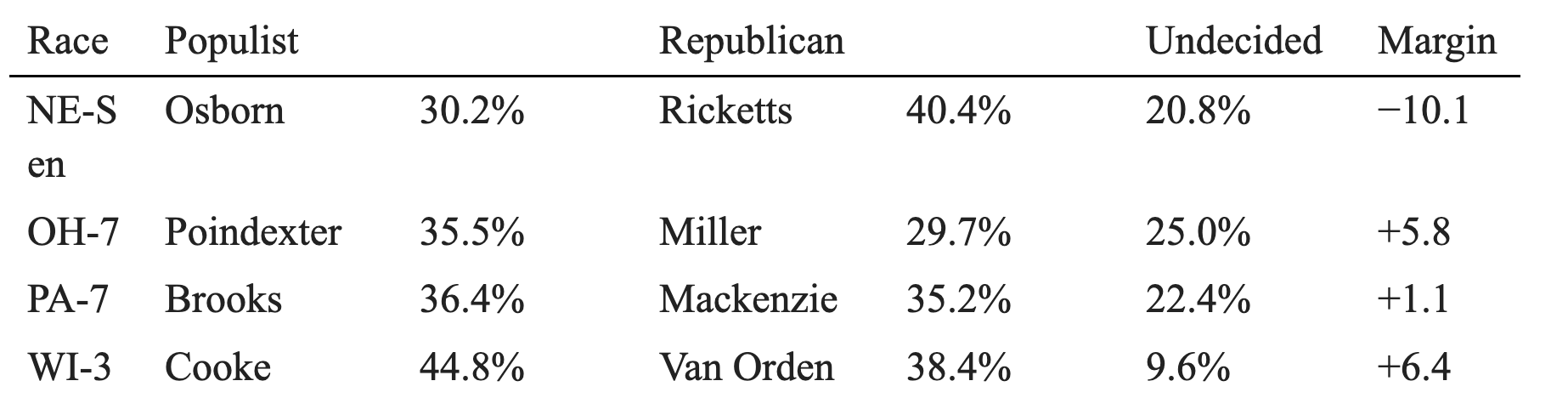
Poindexter’s lead can likely be explained in large part by the fact that his opponent, incumbent congressman Miller, is currently facing grave allegations of domestic violence.
While informative of where the races stand, however, all these figures should be taken with a grain of salt, because many voters have yet to form an impression of the candidates. About one in five likely voters across the four districts have not settled on a candidate for 2026, ranging from 10 percent in Cooke’s district to 25 percent in Poindexter’s. Nearly two-thirds of those undecided voters agreed that the economy is rigged to benefit the wealthy and large corporations. In other words, the voters most likely to decide these races already hold beliefs about the economy and working people that align with the candidates’.
Which voters are working-class economic populists reaching?
One of the central arguments for recruiting working-class candidates is that they can reach working-class voters in a way other candidates cannot.
So far, all four candidates perform worse in our polling among voters without a college degree than among graduates. That is unsurprising given the now well-documented educational divide between the parties. But overcoming that divide is a key part of the argument for recruiting these candidates in the first place.
The question, then, is whether they are doing better with working-class voters than the Democratic Party generally does. To find out, we asked respondents which party they would back for president in 2028 and compared it to their choice for their own 2026 congressional race. The first tells us how a generic Democrat would do with these voters; the second tells us how the actual candidate is doing. The gap between them is the candidate’s own contribution. .
We found that only two of the four candidates, Rebecca Cooke and Dan Osborn, are running ahead of the Democratic Party as a whole, and not necessarily among the groups we’d expect given their working-class bona fides. Relative to a generic Democrat, Cooke is running about four points ahead among voters without a college degree, but is doing even better—five points ahead—among voters with a degree. Osborn’s advantage relative to the Democratic Party is nearly six points among college graduates, but barely one among nongraduates. Poindexter runs roughly even with a generic Democrat among both groups, while Brooks is about three points behind. In short, Cooke is the only one of the four candidates who is gaining support beyond the party baseline among working-class voters, and none of the four show a substantial additional advantage among voters without a four-year college degree compared with graduates.
The picture is similarly mixed when we turn from working-class backgrounds to populist attitudes. Among voters who believe “the economy is rigged to benefit the wealthy and large corporations,” Cooke and Osborne are running about eight to nine points ahead of a generic Democrat. Among those who disagree that the economy is rigged, Cooke’s advantage is about four points and Osborn’s disappears.
The same pattern appears among voters who say politicians do not care about people like them: Cooke is about nine points ahead of the baseline and Osborn seven, compared with roughly no advantage among those who disagree. Poindexter’s gains among these dissatisfied voters are smaller, while Brooks runs behind the baseline.
So while Cooke and Osborn are finding support compared to a generic Democrat among voters who express distrust of the economic and political system, that support is not translating into a distinctive advantage among working-class voters.
Do voters notice the class background of working-class candidates?
It’s also possible that working-class voters don’t relate more to working-class candidates in many cases because they’re not even aware that the candidates have a working-class background. Indeed, we found that even among respondents who had opinions of the candidates, in three of the four cases, less than half said they thought the candidates were from the working class. That said, with one interesting exception (Cooke), Democratic working-class candidates are much more likely to be viewed as working-class than their Republican opponents.
Osborn was the only one of the four candidates who was viewed as working-class by a majority of respondents, and our qualitative responses show that many voters connect their knowledge of Osborn’s class background to their positive impressions of the candidate: “I like that he is not a billionaire, has real-world work experience, and did not grow up with a silver spoon in his mouth,” one voter wrote.
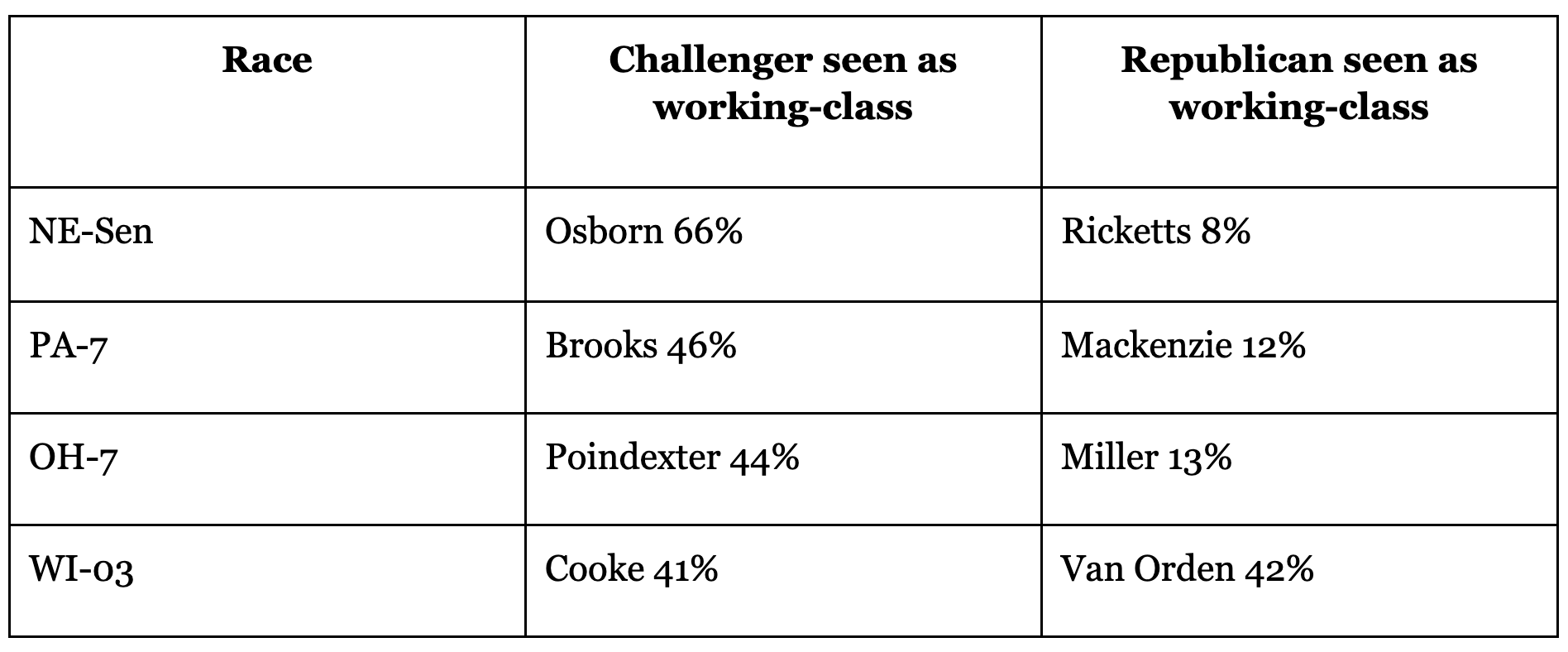
WI-03 district is the only one of the four where the working-class challenger is not viewed as more working-class than their Republican opponent, and this is likely due to the fact that Cooke’s challenger, Van Orden, is a retired Navy SEAL, and voters read military service (particularly as non-officers) as blue-collar work.
What sets working-class economic populists apart from typical Democrats
We know that partisanship ultimately explains the vast majority of election outcomes, so the interesting question is whether working-class economic candidates can reach voters who would otherwise not give Democrats (or Democrat-linked independents) a hearing. For that reason, we asked people to compare each challenger not to their Republican opponent but to typical politicians in the Democratic Party.
All four candidates were seen as further from corporate power and closer to working people than the Democratic Party as a whole:
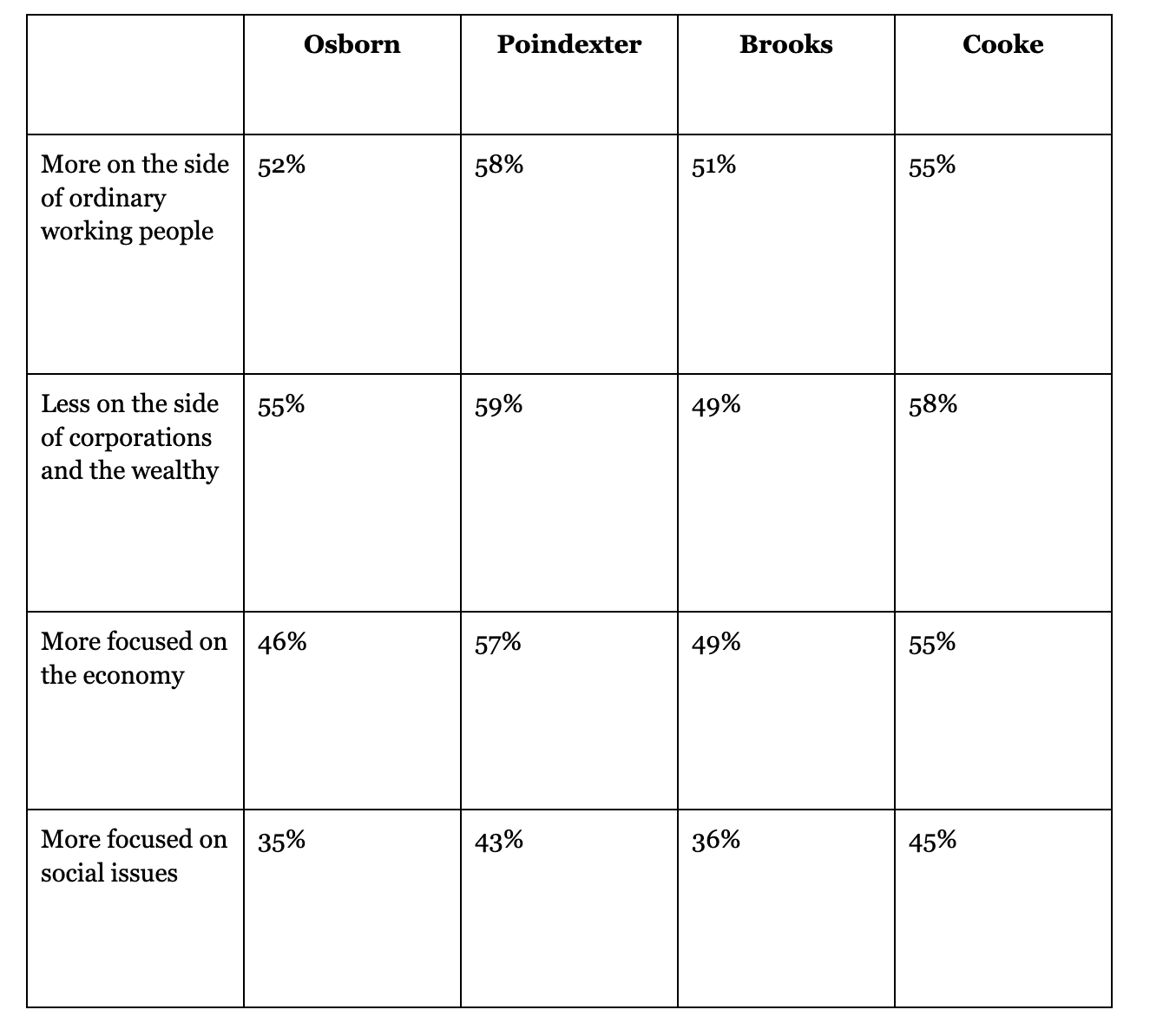
Likewise, the candidates’ message discipline around kitchen table economics is showing up in our data: in every race, more voters believed the candidate prioritized economics over social issues, and in open-ended responses they described, for instance, that “Rebecca Cooke has a solid view on what needs to be done to improve our economy.” And “He [Poindexter] is a blue collar worker and understands that times are tough.”
Even so, between a third and nearly half of voters who expressed any view of these candidates believed they are more focused on social issues than a typical Democrat: Osborn 35 percent, Brooks 36, Poindexter 43, and Cooke 45.
The fact that Osborn and Cooke are viewed as more extreme than the other two candidates is likely a product of exposure to Republican attacks. They are both running for the second and third time, respectively, and have already been through a full general election as the target of Republican attack campaigns. Poindexter and Brooks, by contrast, won their first primaries in May.
Popular
“swipe left below to view more authors”Swipe →
An even more telling fact may be that the numbers are substantial for all four. Between 35 and 45 percent of the voters who have an impression of these candidates say they are more focused on social issues than a typical Democrat. This is even though the candidates are running about the most disciplined kitchen-table economics-focused campaigns in the country this cycle. Poindexter’s site has four issue pages, and every one is about economic issues, with virtually no mention of culture at all. What these campaigns choose to talk about is evidently not enough, on its own, to overcome what skeptical voters already assume about all Democrats—and even independents like Osborn.
When we asked voters to describe each candidate in their own words, their answers suggested why the party brand is so hard to escape. Voters rarely described the candidates themselves, but rather something they felt about the Democratic Party, and then applied it to whichever candidate was in front of them.
In Cooke’s district: “She’s a Democrat. That means she is a thief, a social justice warrior, and against our nation and the constitution.” And: “She is a democrat and I do not agree with much they stand for! They’ve lost their way and go way to SOCIALIST.” In Poindexter’s: “All democrats all socialist. And believe we should live by the communist manifesto, not the constitution.” And: “Do not like any democrat. Just look how out of touch and lack of common sense they have.” In Brooks’s: “He’s a democrat whose party has become more like communist.” And: “He’s a democrat and right now they suck. I cannot believe any democrat would try to get things done for the ordinary person.”
The strongest evidence for how heavy the cost of the Democratic brand has become comes in from the one candidate who isn’t a Democrat. Osborn is running with no party label at all, and Nebraska Democrats declined to field a candidate against him. Voters tagged him anyway: “He’s a wolf in sheep’s clothing pretending to be independent when he’s really a Democrat or even more extreme than some of the Nebraska Democrats.” “Osborn is not an Independent. He is backed 100% by the Democrat Party.” “I don’t like his claim of independence when he is clearly a democrat.”
Reason for optimism
There is more here to encourage economic populists than to discourage them. The four candidates we’re tracking are running competitive races in Republican-leaning seats, and three of them are leading among likely voters. All are seen as more economically focused and more willing to take on corporate power than a typical Democrat. Their biographies, where voters know them, are viewed positively.
But the warning signs are just as clear.
First, with the partial exception of Rebecca Cooke, working-class economic populists are not yet connecting effectively with the working-class, non-college-educated voters they were recruited to reach. If these candidates win in November while running no better than the party label among working-class voters, that would be a welcome result for Democrats’ hopes of retaking the House, but it would tell us very little about whether economic populism can actually reach the voters it is meant to reach. It would also be a precarious way to win in Republican-leaning districts, since candidates whose support comes mainly from voters any Democrat would have won is at the mercy of the national political environment. If the party’s standing slips, there is no additional support to cushion the fall.
In addition, even the strongest candidate can still be dragged down by the weight of the Democratic Party brand. For instance, in 2024 Sherrod Brown in Ohio and Matt Cartwright in Pennsylvania both ran exactly the kind of economic campaign this research recommends, both ran well ahead of the top of their tickets, and both lost anyway.
That is the real test this fall, with implications that go far beyond these four races. Working-class voters have been leaving the Democratic coalition for decades, and in recent years the party has finally started to test the power of finding candidates who look and sound like the working-class voters it lost. If these four can convert a shared belief that the economy is rigged and that they’re going to deliver for working people into votes, we will have a blueprint for how to overcome Democrats’ deepest vulnerabilities with working-class voters.
Stay tuned for next month’s installment of the Economic Populist Tracker.
Between the reemergence of right-wing red-baiting and Donald Trump’s use of the chilling National Security Presidential Memorandum–7 to criminalize left political organizing, we’re seeing McCarthyism reborn before our eyes.
This assault on democracy cannot be ignored or wished away. Resisting it requires bravery in the face of threats and repression, a steadfast commitment to the truth, and the unwavering belief that we can—and will—overcome this darkness.
We must have an independent media that sets the record straight, unearths corruption and abuses of power, and advances a politics of justice and dignity for all if we’re to win this fight.
That’s why I’m writing to you today. This September, The Nation needs to add 100 monthly donors to sustain our progressive journalism. Your contribution makes the next investigative report, the next truth-speaking column, and the next pathbreaking essay all possible.
I hope you’ll support our work with a recurring donation today. If you donate $10 or more a month, we’ll send you a brand new “Hands Off the Free Press!” sticker to recognise your commitment to our cause. Please, donate today.
Onward,
Katrina vanden Heuvel
Editor and Publisher, The Nation
More from The Nation
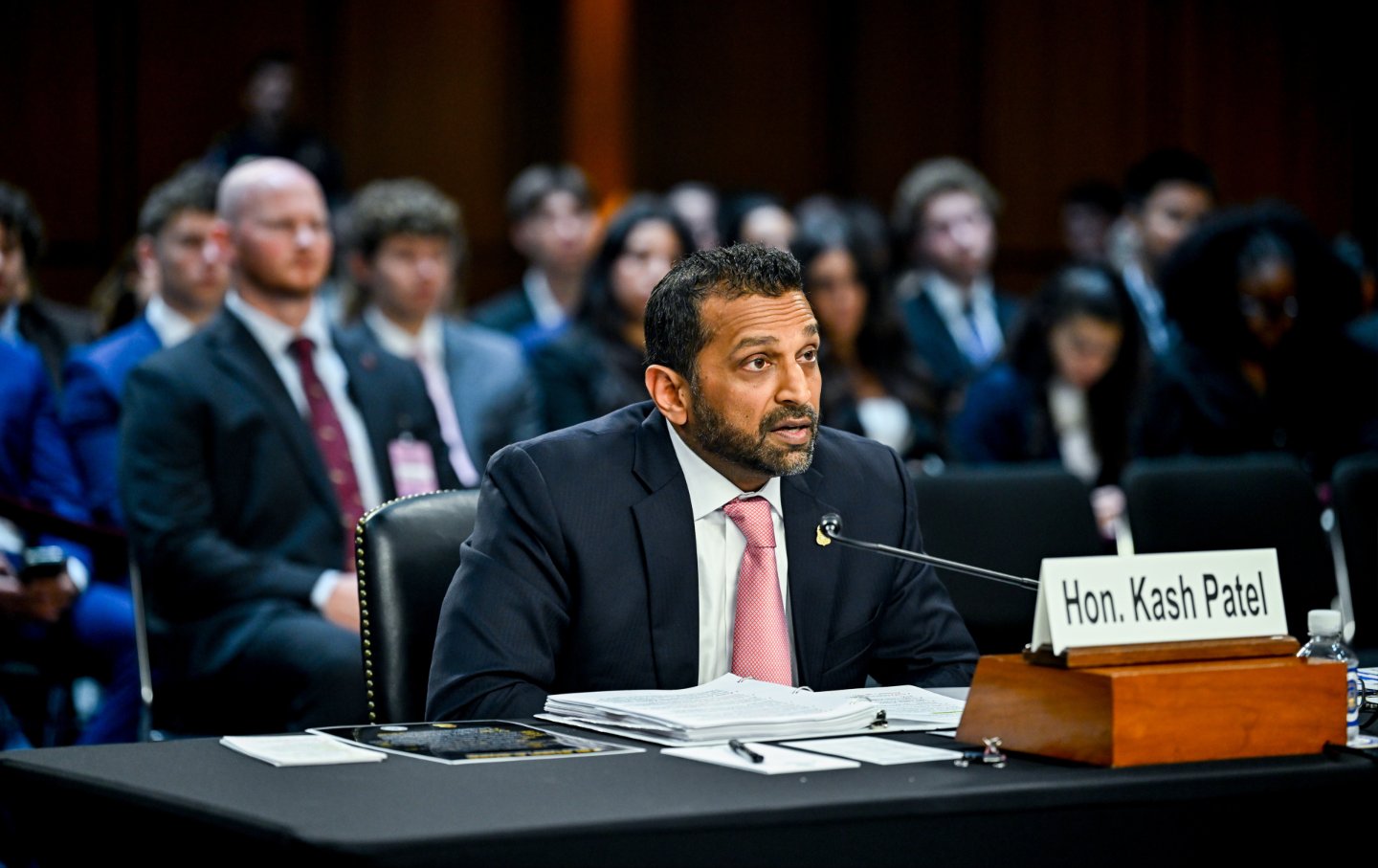
In a bizarre Senate committee hearing, the FBI director defends his tenure and disrespects Democrats.
Joan Walsh

The crusade against ballot access, like virtually every other facet of Trump’s agenda, does nothing to serve the interests of “the people,” but our press is too brain-dead to noti…
Column
/
Chris Lehmann

A spontaneous memorial honoring Gloria Steinem (March 25, 1934–September 2, 2026), an extraordinary woman, leader, and lifelong force for equality. New York City, September 2026.
OppArt
/
Andrea Arroyo

