


According to S&P Global, inflows of new work increased to the greatest extent in five months.
| Photo Credit:
REUTERS/PRIYANSHU SINGH
India’s private services sector saw better activities at the domestic front, as Purchasing Managers’ Index (PMI) for serviced rose to five months high of 58.8 in April, S&P Global reported on Wednesday. Important to note that inflationary pressure saw mild reduction in the said month. March’s headline was 57.5.
“Activity and new orders strengthened, even as new export orders eased, suggesting that demand is rotating from overseas markets to domestic consumers amid the Middle East conflict,” Pranjul Bhandari, Chief India Economist at HSBC, said. PMI is derived based on responses from purchasing managers of 400 firms. Index above 50 means expansion, while below 50 reflects contraction.
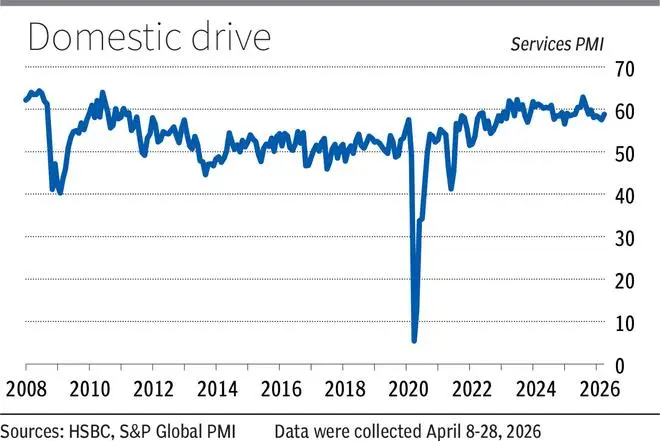
According to S&P Global, inflows of new work increased to the greatest extent in five months. Survey participants said that competitive pricing, e-commerce and particularly strong customer demand for relocation and logistic services boosted sales growth. Consumer Services led April’s expansion in new orders and output, followed by Transport, Information & Communication. Growth of international demand for Indian services lost strength. “Companies indicated that the war in the Middle East and subdued inbound tourism dampened the expansion. The seasonally adjusted New Export Business Index fell by more than five points and reached its second-lowest print in over a year,” the agency said.
Further, Indian services companies were confident of a rise in output over the course of the coming 12 months. Optimism was supported by forecasts of demand growth, marketing initiatives and rising client enquiries. The level of positive sentiment nevertheless fell from March, dampened by worries surrounding the war in the Middle East and cost pressures. Still, companies recruited more workers at the start of the first fiscal quarter, the agency added.
“Input cost inflation moderated but remained elevated, while output price inflation stayed subdued, indicating that some firms are absorbing higher costs rather than passing them on,” Bhandari said.
Meanwhile, rising volumes of new business boosted the recruitment of short-term staff and junior-level trainees. Quicker expansions in employment were noted in each of the four broad areas of the service economy monitored by the survey. Sustained hiring growth enabled firms to reduce outstanding business levels for the first time in four months. The rate of backlog depletion was only marginal, however, the agency said.
Published on May 6, 2026

